Making Your First Ham Radio Contact (Scripts Included)
Listen to your local repeater for a day, then key up during a quiet moment and say your call sign followed by "monitoring" — for example, "KD2ABC, monitoring." Anyone who answers will carry the conversation from there. Identify with your call sign every 10 minutes and when you sign off (FCC rule 97.119), pause a beat before replying, and don't call "CQ" on repeaters. Nerves are universal; hams are famously kind to new voices.
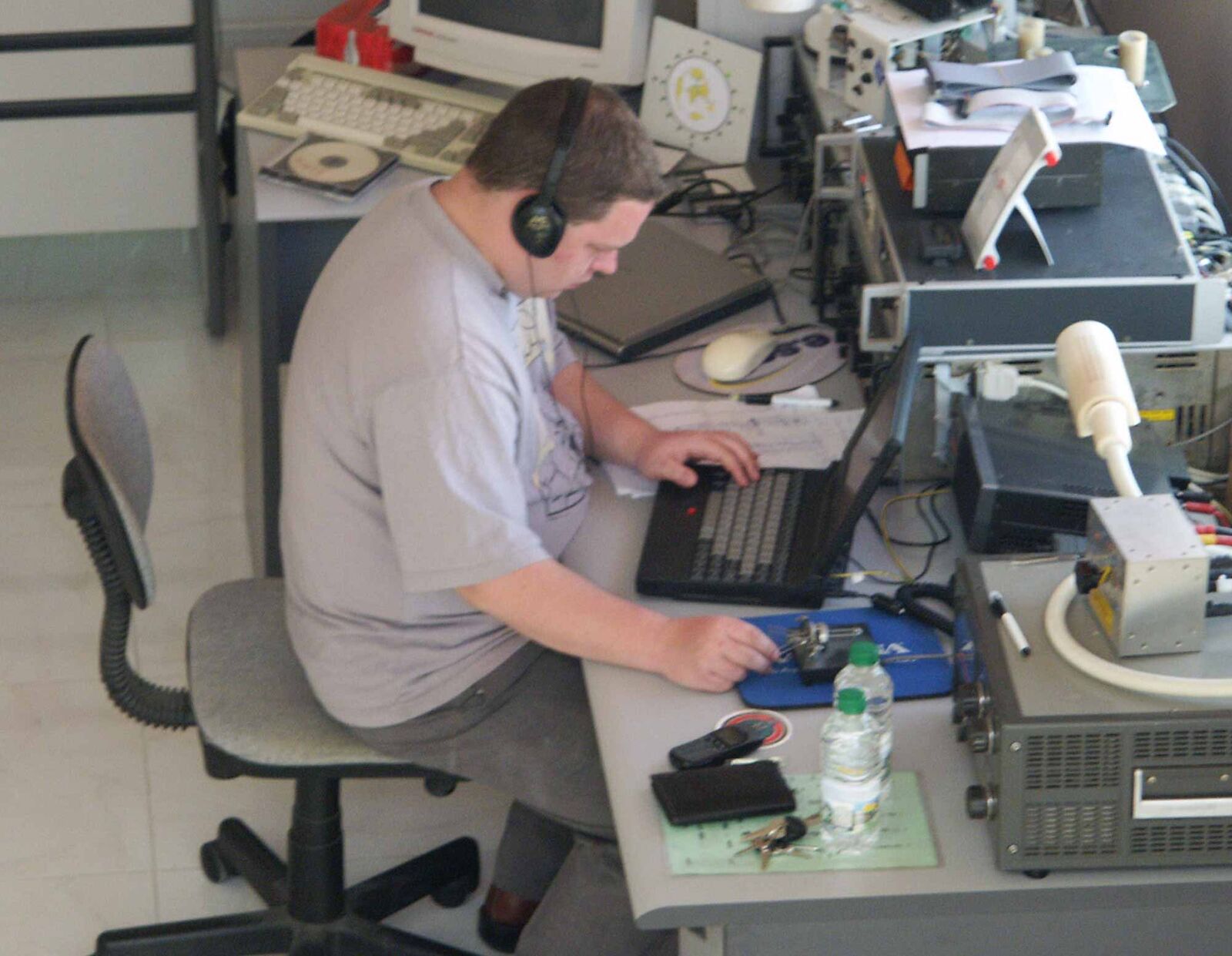
Mic fright is real. Nearly every licensed ham sat in the car or the kitchen for days, thumb hovering over the PTT button, rehearsing a sentence nobody would ever critique. Here's the secret: the other stations want to hear you — a new call sign on the local repeater is the most interesting thing that happens all week.
This guide gives you word-for-word scripts for repeater and simplex contacts, the etiquette that marks you as someone who listened first, the FCC identification rule you actually have to follow, plus the phonetic alphabet and starter Q-codes. Get your radio programmed first (CHIRP guide) and know which repeaters are active near you.
Before you transmit: the 20-minute prep
Three things make the first contact easy instead of terrifying:
- Listen for a while. Monitor the busiest local repeater through a commute hour or an evening net. You'll absorb the local rhythm — how people ID, how long they pause, what the courtesy tone sounds like.
- Verify your setup works. Correct output frequency, offset, and CTCSS tone (the offset calculator confirms the numbers). If the repeater has an ID or beep after your test, you're getting in.
- Write your call sign phonetically on a sticky note. Under adrenaline, everyone blanks. "Kilo Delta Two Alfa Bravo Charlie" on paper removes the one thing you might fumble.
The repeater script: 'monitoring' beats 'CQ'
On repeaters, you don't call CQ (that's an HF and simplex custom). You simply announce that you're around:
- You: "KD2ABC, monitoring."
- Them: "KD2ABC, this is W2XYZ. Good evening!"
- You: "W2XYZ from KD2ABC — thanks for the call! My name is Sam, and you're actually my first contact. I'm on a handheld in Riverside."
That's it. Mentioning it's your first contact is a cheat code — expect congratulations, signal reports, and probably an invitation to the club net. To join a conversation already in progress, wait for the pause between transmissions and say just your call sign: the participants will invite you in. Never say "BREAK" to join casually — many regions reserve break/break-break for urgent or emergency traffic.
The FCC identification rule (the only script you must follow)
FCC rule 97.119 requires exactly one thing: transmit your call sign at the end of a communication and at least every 10 minutes during one. In English, use of the phonetic alphabet is encouraged for clarity. That's the entire legal requirement — everything else in this guide is custom, not law.
What it looks like in practice: give your call when you first join, roughly every 10 minutes in a long ragchew (the courtesy-tone pause is a natural moment), and once more when you sign off: "Thanks for the QSO — 73, KD2ABC, clear."
The phonetic alphabet: learn it once, use it forever
Hams spell call signs and names with the NATO/ICAO alphabet so letters can't be confused (B, D, E, and V all sound alike on a noisy channel):
| NATO phonetic alphabet | |||
|---|---|---|---|
| A Alfa | B Bravo | C Charlie | D Delta |
| E Echo | F Foxtrot | G Golf | H Hotel |
| I India | J Juliett | K Kilo | L Lima |
| M Mike | N November | O Oscar | P Papa |
| Q Quebec | R Romeo | S Sierra | T Tango |
| U Uniform | V Victor | W Whiskey | X X-ray |
| Y Yankee | Z Zulu | Numbers: spoken normally | |
Use phonetics for your call sign the first time you give it and whenever anyone asks for a repeat; plain letters are fine once the other station has you.
Starter Q-codes and lingo (just enough, not the whole dictionary)
You'll hear these constantly; you only need a handful to sound fluent:
| Term | Meaning in conversation |
|---|---|
| QSO | A contact/conversation ("my first QSO") |
| QTH | Location ("my QTH is Riverside") |
| QRM | Interference ("some QRM on frequency") |
| QRZ? | "Who's calling me?" |
| QSL | "Understood / confirmed" |
| QRT | Shutting down ("going QRT") |
| 73 | Best regards — the universal sign-off |
| Ragchew | A long casual conversation |
| Kerchunk | Keying a repeater without speaking (do it with your call sign, not silently) |
More vocabulary lives in the ham radio glossary whenever something new flies past.
Simplex and nets: your next two firsts
Two graduation steps after the first repeater QSO:
- Simplex: radio-to-radio on 146.520 MHz (2 m) or 446.000 MHz (70 cm) — no offset, no tone. Here "CQ" is appropriate: "CQ CQ, this is KD2ABC calling on one-four-six-five-two, anyone around?" Make contact, then move off the calling frequency to another simplex channel to chat. Range is line-of-sight, typically 1–5 miles between handhelds — the physics is in how far can a ham radio transmit.
- Nets: scheduled on-air gatherings, usually weekly on a club repeater. When the net control station calls for check-ins, give your call phonetically, your name, and location. Nets are the single most beginner-friendly structure in ham radio — the format tells you exactly when to talk.
Common first-contact worries, answered honestly
- "What if I mess up?" You will, slightly, and nobody cares. Fumbled phonetics and forgotten IDs are corrected gently or ignored.
- "What if nobody answers?" Common on quiet repeaters. It's not you — try drive time, or the net. Two or three "monitoring" calls in a session is plenty.
- "Am I talking too long?" Pause a beat before replying (lets others break in, and lets the repeater's timer reset), and hand the conversation back every minute or so. You'll match the local pace within a week.
- "Do I need to log contacts?" Not legally for casual FM. Many hams keep a simple notebook anyway — your first QSO deserves a written line.