Work the ISS and Ham Satellites with a Handheld Radio
A Technician license, a 5-watt dual-band handheld, and a small handheld Yagi are enough to talk through satellites. Listen to the ISS on 145.800 MHz with any radio; work its cross-band repeater by transmitting on 145.990 MHz with a 67.0 Hz tone and listening on 437.800 MHz. FM birds like SO-50 (145.850 up / 436.795 down) work the same way. Program channels stepped ±10 kHz around the 70 cm side for Doppler shift, and check pass times before you head outside.
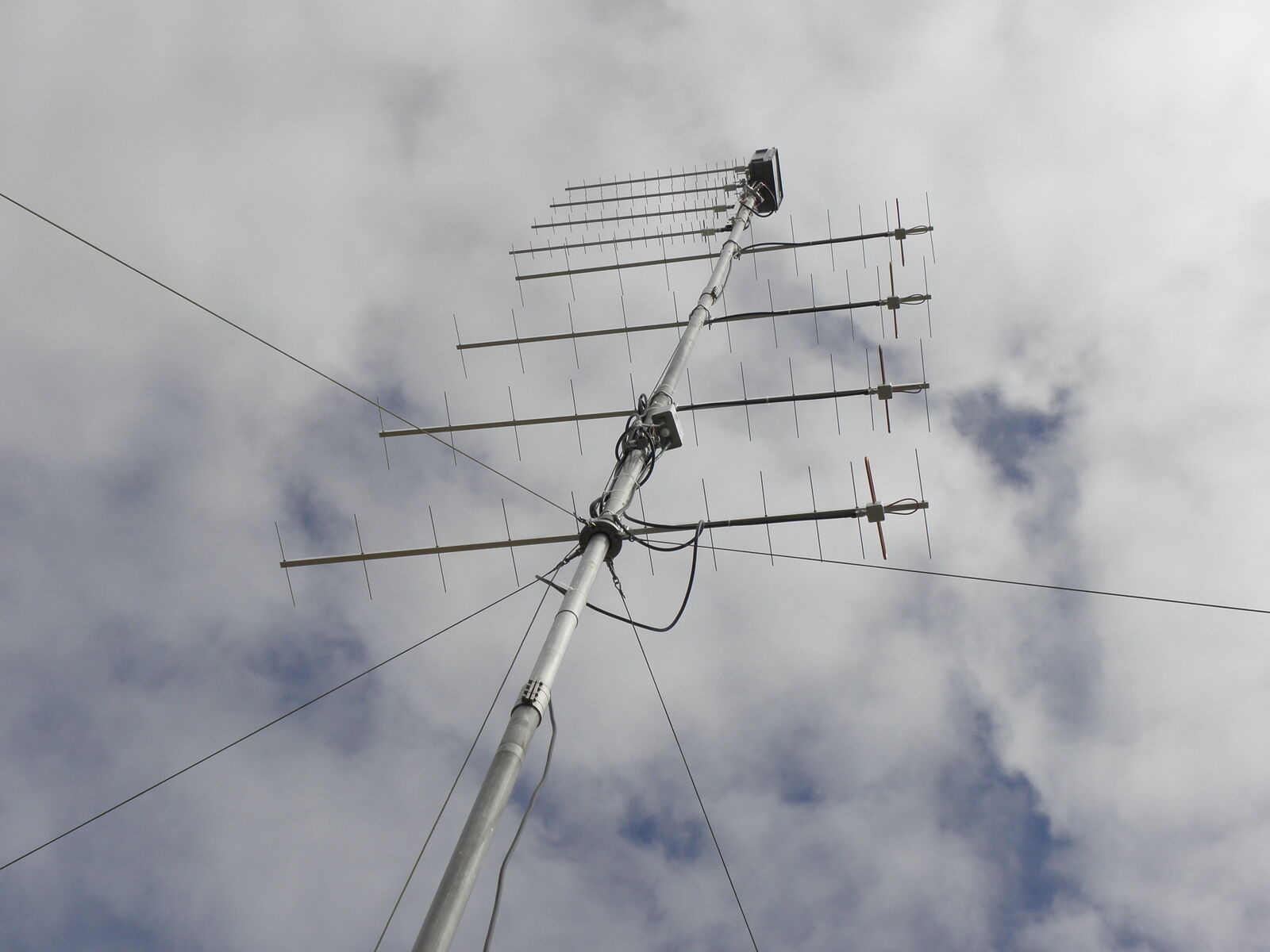
Talking to space sounds like an elite achievement reserved for big antenna farms. It isn't: the amateur gear aboard the International Space Station and the FM "easy-sat" satellites were designed precisely so that a student with a handheld can get through. Hundreds of school contacts with astronauts happen on exactly that class of equipment.
This guide gives you the frequencies, the Doppler channel trick, and a realistic first-pass plan. Everything here sits inside Technician privileges — satellites are arguably the coolest thing the entry license unlocks.
How a satellite pass works
Amateur satellites in low orbit cross your sky in arcs lasting roughly 5–12 minutes, a few times a day. Three moments matter: AOS (acquisition of signal — it rises), TCA (time of closest approach — strongest signals), and LOS (loss of signal — it sets). Higher-elevation passes are easier; a pass peaking 20° above the horizon is workable, one peaking 70° is easy mode.
FM satellites and the ISS repeater are cross-band: you transmit up on one band (usually 2 m) and listen down on the other (usually 70 cm), so your own transmission can't block your receive. One satellite carries one conversation at a time — passes are polite, quick exchanges of call signs and grid squares, not ragchews.
The ISS: three ways to hear (and use) the space station
The amateur station aboard the ISS (ARISS) offers three targets, all FM:
| ISS activity | Uplink | Downlink | Who can use it |
|---|---|---|---|
| Crew voice contacts | 144.490 (Region 2/3) | 145.800 | Listen: anyone. Talking to crew: mostly scheduled school contacts, plus rare casual passes |
| Cross-band repeater | 145.990 (67.0 Hz tone) | 437.800 | Any licensed ham — this is the everyday target |
| APRS digipeater | 145.825 (both ways) | Packet stations and APRS handhelds | |
Start by just listening on 145.800 MHz during a pass — no license needed, and hearing the repeater downlink confirms your timing and antenna technique before you ever transmit. The repeater is switched off during dockings and spacewalks, so check the ARISS status page if a pass is silent.
The FM 'easy sats': SO-50 and friends
Beyond the ISS, volunteer-built FM satellites act as flying repeaters. The current beginner staples:
| Satellite | Uplink (MHz) | Downlink (MHz) | Notes |
|---|---|---|---|
| SO-50 | 145.850 (67.0 Hz) | 436.795 | The classic; a 2-second carrier with 74.4 Hz tone arms its 10-minute timer if it's idle |
| AO-91 | 435.250 (67.0 Hz) | 145.960 | Aging battery — use on sunlit passes only, per AMSAT's request |
Fleet status changes as satellites age and new ones launch; AMSAT's live FM satellite page is the authoritative scoreboard. The technique below transfers to whatever is flying.
Gear: what you need (and the Doppler channel trick)
The minimum kit that reliably works satellites:
- A dual-band 5 W handheld. Any of our beginner picks qualifies. Full-duplex radios (hear the downlink while transmitting) are a luxury upgrade, not a requirement.
- A handheld directional antenna. The Arrow II and Elk log-periodic are the community standards; a printed-tape-measure Yagi built from a $15 parts list works too. The stock rubber duck occasionally squeaks through on high passes, but a small beam transforms the experience.
- Doppler channels. Motion shifts the 70 cm side by roughly ±10 kHz across a pass (2 m barely moves). Program five memories stepping the 70 cm frequency: for SO-50, listen on 436.805 → 436.800 → 436.795 → 436.790 → 436.785 as the pass progresses, keeping the 145.850 uplink (67.0 Hz tone) constant. Step down a channel whenever audio gets scratchy.
- A pass predictor. Any satellite app or AMSAT's online pass predictions — you need azimuth (where it rises), maximum elevation, and times.
Your first pass, minute by minute
- Pick a good pass: maximum elevation above 30°, over open sky, ideally daytime for SO-50 practice.
- Set up 10 minutes early: channels loaded, volume up, squelch OPEN (satellite signals are weak and fluttery — squelch will eat them).
- At AOS, point the antenna at the rise point and sweep slowly; twist the antenna (polarization) when signals flutter. Find the downlink first. Don't transmit until you can hear the bird.
- Work the exchange: in a gap, transmit "KD2ABC, Foxtrot November two-zero" (your call + grid square, phonetically). A reply of your call, their call, and their grid is a complete, logged satellite contact. Grid squares are the currency — get yours from the grid square locator.
- At LOS, log who you heard and worked. Zero contacts on a first pass is normal; hearing the bird clearly IS the first milestone.
Why satellites make you a better operator
Satellite work compresses every VHF/UHF skill into ten-minute drills: reading pass geometry teaches line-of-sight thinking, chasing Doppler teaches frequency discipline, tone-gated birds teach CTCSS fluency, and one-shot exchanges teach crisp phonetics better than any ragchew. It's also the gateway drug: many satellite operators graduate to linear (SSB) birds, then to EME and weak-signal work — a whole career of challenges that started with a Baofeng pointed at the sky.